Sudoku technique · Candidate elimination

Hidden Triple

A Hidden Triple appears when three digits each have at least one candidate position in a row, column, or box and the union of all their positions is exactly the same three cells.

Topic role
Candidate-elimination proof
Engine rank
Rank 7
Play a Sudoku puzzleView all techniques
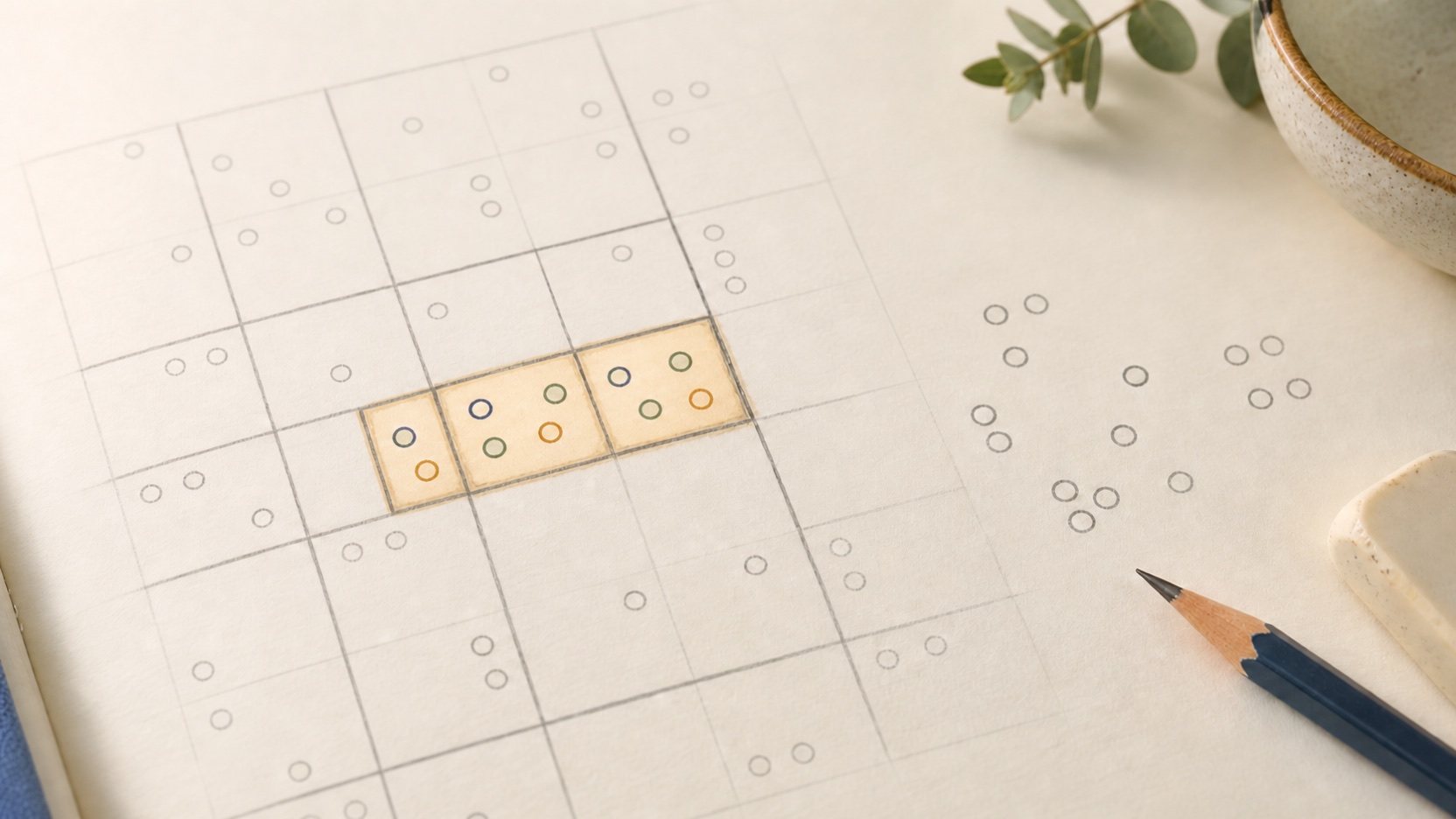
An abstract Sudoku candidate-note study with three adjacent highlighted cells and coloured pencil marks
A conceptual candidate-note study. The verified board below carries the exact cells and eliminations.

Guide updated

Positions first

What a Hidden Triple actually proves

Candidate notes record which digits can still occupy an empty cell without breaking the row, column and 3×3 box constraints. A Hidden Triple reverses the usual way of reading those notes: choose three missing digits in one unit, then ask where each digit can go.

If every position for those three digits is contained in the same three cells, the cells must eventually hold those digits in some order. The useful result is inside the pattern cells: every candidate other than the chosen three can be removed.

The three position lists do not have to match. After resolving any Hidden Single, each chosen digit may appear in two or three of the cells. What matters is that every occurrence of those digits in the unit lies inside the same three-cell union.

  • Keep the three chosen digits in the pattern cells.
  • Remove candidates outside the triple from those same cells.
  • If one of the three digits still appears as a candidate elsewhere in the unit, the Hidden Triple has not been established; recompute before deleting anything.

Four checks

How to find Hidden Triples without guessing

Use the same sequence every time: define one unit, count positions by digit, test the union, then confirm an exact elimination.

  1. 1. Scan one unit at a time

    Work inside one row, column or 3×3 box. List the digits missing from that unit, then map the cells in which each digit remains a candidate. Positions taken from different units cannot prove one Hidden Triple.

  2. 2. Choose three digits with small position sets

    After resolving any Hidden Single, look for digits that each appear in two or three candidate cells within the unit. A larger position set cannot be confined to three cells. Do not reject a group merely because its three lists differ.

  3. 3. Test the union of their positions

    Combine the three position lists. Exactly three cells establishes the positional part of the pattern. Four or more cells means there is no Hidden Triple. Only two cells for three missing digits is a contradiction; recompute candidates and revisit earlier entries before continuing.

  4. 4. Confirm that an elimination exists

    At least one pattern cell must contain a candidate outside the chosen digits. Remove only those extras, then update the affected units. If the cells already contain only the triple digits, the relationship is true but produces no new solving step.

Learning order

Topic relationships

These links express the same learning and proof relationships used throughout the library.

Verified example

Work through the example

Hidden Triple · Verified example
R1C1: empty
R1C2: empty
R1C3: given 9
R1C4: given 7
R1C5: empty
R1C6: given 1
R1C7: empty
R1C8: empty
R1C9: empty
R2C1: empty
R2C2: empty
R2C3: empty
R2C4: given 9
R2C5: empty
R2C6: given 4
R2C7: empty
R2C8: given 5
R2C9: empty
R3C1: given 8
R3C2: empty; pattern cell; candidate deletion 2, 6; Before 1, 2, 4, 6, 7; After 1, 4, 7
R3C3: empty
R3C4: empty
R3C5: empty
R3C6: empty
R3C7: given 9
R3C8: empty; pattern cell; candidate deletion 2, 3, 6; Before 1, 2, 3, 6, 7; After 1, 7
R3C9: empty; pattern cell; candidate deletion 2, 3; Before 1, 2, 3, 4, 7; After 1, 4, 7
R4C1: given 4
R4C2: given 3
R4C3: empty
R4C4: empty
R4C5: empty
R4C6: given 9
R4C7: empty
R4C8: empty
R4C9: empty
R5C1: empty
R5C2: empty
R5C3: empty
R5C4: empty
R5C5: empty
R5C6: empty
R5C7: given 6
R5C8: empty
R5C9: given 9
R6C1: empty
R6C2: empty
R6C3: given 1
R6C4: given 8
R6C5: given 7
R6C6: empty
R6C7: empty
R6C8: empty
R6C9: empty
R7C1: empty
R7C2: empty
R7C3: given 5
R7C4: empty
R7C5: empty
R7C6: empty
R7C7: empty
R7C8: given 4
R7C9: empty
R8C1: given 3
R8C2: empty
R8C3: given 7
R8C4: empty
R8C5: empty
R8C6: given 2
R8C7: empty
R8C8: empty
R8C9: given 5
R9C1: empty
R9C2: empty
R9C3: given 4
R9C4: empty
R9C5: given 5
R9C6: empty
R9C7: given 2
R9C8: empty
R9C9: given 6

Pattern cells: R3C2, R3C8, R3C9. Remove 2, 6 from R3C2; Remove 2, 3, 6 from R3C8; Remove 2, 3 from R3C9.

Pattern cells
R3C2, R3C8, R3C9
Pattern digits
1, 4, 7
Unit in this example
Row 3

Exact candidate changes

  • Remove 2, 6 from R3C2Before: 1, 2, 4, 6, 7After: 1, 4, 7
  • Remove 2, 3, 6 from R3C8Before: 1, 2, 3, 6, 7After: 1, 7
  • Remove 2, 3 from R3C9Before: 1, 2, 3, 4, 7After: 1, 4, 7
  1. Choose one unit and map the candidate positions of each missing digit.
  2. Find three digits whose combined candidate positions occupy exactly three cells.
  3. Reserve those cells for the three digits without deciding which digit goes where.
  4. Remove only the non-triple candidates from those three pattern cells.

Do not reverse the deletion

Hidden Triple vs Naked Triple

Both patterns reserve three digits for three cells, but they expose different evidence and remove candidates in opposite places.

Hidden Triple and Naked Triple evidence and elimination directions
QuestionHidden TripleNaked Triple
What do you scan first?Candidate positions of three digitsCandidate contents of three cells
What is confined?Three digits to three cellsThree cells to three digits
Where do you remove candidates?Extra digits inside the three pattern cellsThe triple digits from other cells in the unit
Must every cell show all three digits?NoNo; each cell can hold a subset of the same three-digit union

Fixed practice

Count positions by digit, then combine three position lists and check that their union is exactly three cells.

Fixed practice · R2C7
Hidden Triple · Fixed practice
R1C1: given 3
R1C2: given 8
R1C3: given 5
R1C4: given 6
R1C5: empty
R1C6: given 1
R1C7: empty
R1C8: empty
R1C9: empty
R2C1: given 1
R2C2: empty
R2C3: given 9
R2C4: given 5
R2C5: empty
R2C6: empty
R2C7: empty; pattern cell; candidate deletion 2, 4, 7; Before 2, 3, 4, 6, 7, 8; After 3, 6, 8
R2C8: empty
R2C9: empty; pattern cell; candidate deletion 4, 7; Before 3, 4, 6, 7, 8; After 3, 6, 8
R3C1: empty
R3C2: given 2
R3C3: empty
R3C4: empty
R3C5: given 3
R3C6: empty
R3C7: given 5
R3C8: given 1
R3C9: empty; pattern cell; candidate deletion 4, 7, 9; Before 4, 6, 7, 8, 9; After 6, 8
R4C1: empty
R4C2: empty
R4C3: empty
R4C4: empty
R4C5: empty
R4C6: given 5
R4C7: empty
R4C8: empty
R4C9: empty
R5C1: empty
R5C2: given 3
R5C3: empty
R5C4: empty
R5C5: given 1
R5C6: empty
R5C7: empty
R5C8: given 6
R5C9: empty
R6C1: empty
R6C2: empty
R6C3: empty
R6C4: given 4
R6C5: empty
R6C6: empty
R6C7: empty
R6C8: empty
R6C9: empty
R7C1: empty
R7C2: given 1
R7C3: given 7
R7C4: empty
R7C5: given 5
R7C6: empty
R7C7: empty
R7C8: given 8
R7C9: empty
R8C1: empty
R8C2: empty
R8C3: given 3
R8C4: given 1
R8C5: empty
R8C6: empty
R8C7: given 9
R8C8: empty
R8C9: empty
R9C1: empty
R9C2: empty
R9C3: empty
R9C4: empty
R9C5: empty
R9C6: given 7
R9C7: given 1
R9C8: given 3
R9C9: given 2

Pattern cells: R2C7, R2C9, R3C9. Remove 2, 4, 7 from R2C7; Remove 4, 7 from R2C9; Remove 4, 7, 9 from R3C9.

Pattern cells
R2C7, R2C9, R3C9
Pattern digits
3, 6, 8
Unit in this example
Box 3

Exact candidate changes

  • Remove 2, 4, 7 from R2C7Before: 2, 3, 4, 6, 7, 8After: 3, 6, 8
  • Remove 4, 7 from R2C9Before: 3, 4, 6, 7, 8After: 3, 6, 8
  • Remove 4, 7, 9 from R3C9Before: 4, 6, 7, 8, 9After: 6, 8

Common mistakes

Common mistakes

Requiring identical candidate lists

The pattern is about the union of positions, not three matching note strings. The reviewed example remains valid even though r3c8 has no candidate 4.

Removing the triple digits elsewhere

For a Hidden Triple, new eliminations occur inside the three reserved cells. If a chosen digit still appears elsewhere in the unit, the pattern is not established yet.

Declaring a step with no elimination

If the three cells already contain only the chosen digits, there is nothing to remove. The relationship may be useful, but it is not a new deduction.

Expecting an immediate answer

A Hidden Triple narrows candidates; it need not place a digit or finish the puzzle. Its value may appear only after the crossing units are rescanned.

Verification details

What is verified here

The independent verifier recomputes each digit’s non-empty position set, confirms that their union is the exact three pattern cells, and checks every extra candidate removed only from those cells.

Example reference
p3c-hidden-triple-row-01 / p3c-hidden-triple-box-01
Engine version
legen-sudoku-engine/1.3.0
Example verification
Verified candidate-elimination step
Last checked
2026-07-18
The coordinates, candidates, and results on these pages come from reproducible board states and are checked with the published engine.

Quick answers

Hidden Triple FAQs

What is a Hidden Triple in Sudoku?

A Hidden Triple occurs when three missing digits have all their candidate positions confined to exactly three cells within one row, column or box. Those cells must contain the three digits in some order, so their other candidates can be removed.

Do all three digits need to appear in all three cells?

No. After Hidden Singles are resolved, each chosen digit may appear in two or three of the pattern cells. The individual position lists may differ, but every occurrence in the unit must stay inside their combined three-cell set.

Which candidates can a Hidden Triple eliminate?

Remove candidates outside the chosen three digits from the three pattern cells. If a chosen digit still appears elsewhere in the unit, recheck the notes because the Hidden Triple is not established.

Further reading

Rules and method references

Check the general rule and subset method in the external references below; the exact example on this page remains sourced from Legen Sudoku’s own reviewed fixture.

Put it into practice

Count positions, then remove only the extras

A reliable Hidden Triple is not a visual hunch. Verify one unit, three non-empty digit-position sets, their exact three-cell union and the direction of every deletion. Precision matters more than whether the candidate notes look tidy.

The playable Hint currently covers Naked and Hidden Singles rather than promising Hidden Triple detection on demand. Use this guide to check your own notes, or review Candidate Notes and Naked Triples before trying the pattern in a puzzle.

Play a Sudoku puzzleReview Candidate NotesCompare Naked Triples